
Performance Vs Capability
Why "Doing Everything Right" Makes You Feel Like Shit
You've been disciplined. You tried tracking the macros. You hit your zones. You followed the programme with the kind of precision your mates don't understand.
And you felt worse than ever.
Not physically—the numbers looked good. Definitely lost some weight. Your resting heart rate came down. Your performance metrics went up.
But something fundamental was missing.
You couldn't join the spontaneous weekend hike with your mates because "it's not in the programme." You skipped your kid's pizza night because you needed to hit 250g carbs, not 320g. Your knee felt dodgy, so you stopped training completely for 3 weeks instead of just backing off slightly.
And that made you more frustrated than before—is this really the cost of being capable? Removing the things you wanted to be fit for in the first place?
You were on the way to being "fitter" than you'd ever been...
But you felt less capable than you did five years ago.
So you jacked it in after four weeks. Maybe eight if you're stubborn.
And now you're back where you started. Except this time you feel like you failed. Like you don't have what it takes. Like maybe you're just not disciplined enough.
But here's what actually happened:
You didn't fail. The approach failed you.
There's a reason that happened.
The Two Paths (And Why Everyone's Walking the Wrong One)
Let me show you something most people don't see.
There are two completely different goals you can pursue with training. They're not just different—they're often opposite. And confusing one for the other is why you got frustrated and quit.
Maybe you've tried this cycle a few times:
Get motivated. Follow a "science-based" programme. See initial results. Realize you're sacrificing everything that matters. Jack it in. Feel like you failed.
Try again six months later. Same pattern.
You didn't fail. You were succeeding at the wrong thing.
High Performance: Shaving 0.1 seconds off a 400-metre run. Increasing your FTP by 5 watts. Lower marathon time. Specific, measurable outputs under controlled conditions.
Capability: Walking into a room and taking up space. Carrying both your kids up a hill without anxiety. Sprinting when needed. Training effectively on 5 hours sleep because you were up with the baby. Handling spontaneous physical demands without worrying something's going to break.
These aren't slightly different approaches to the same goal. They require fundamentally opposite methods.
And here's where it gets interesting: the protocols that build high performance don't just fail to build capability.
They actively destroy it.
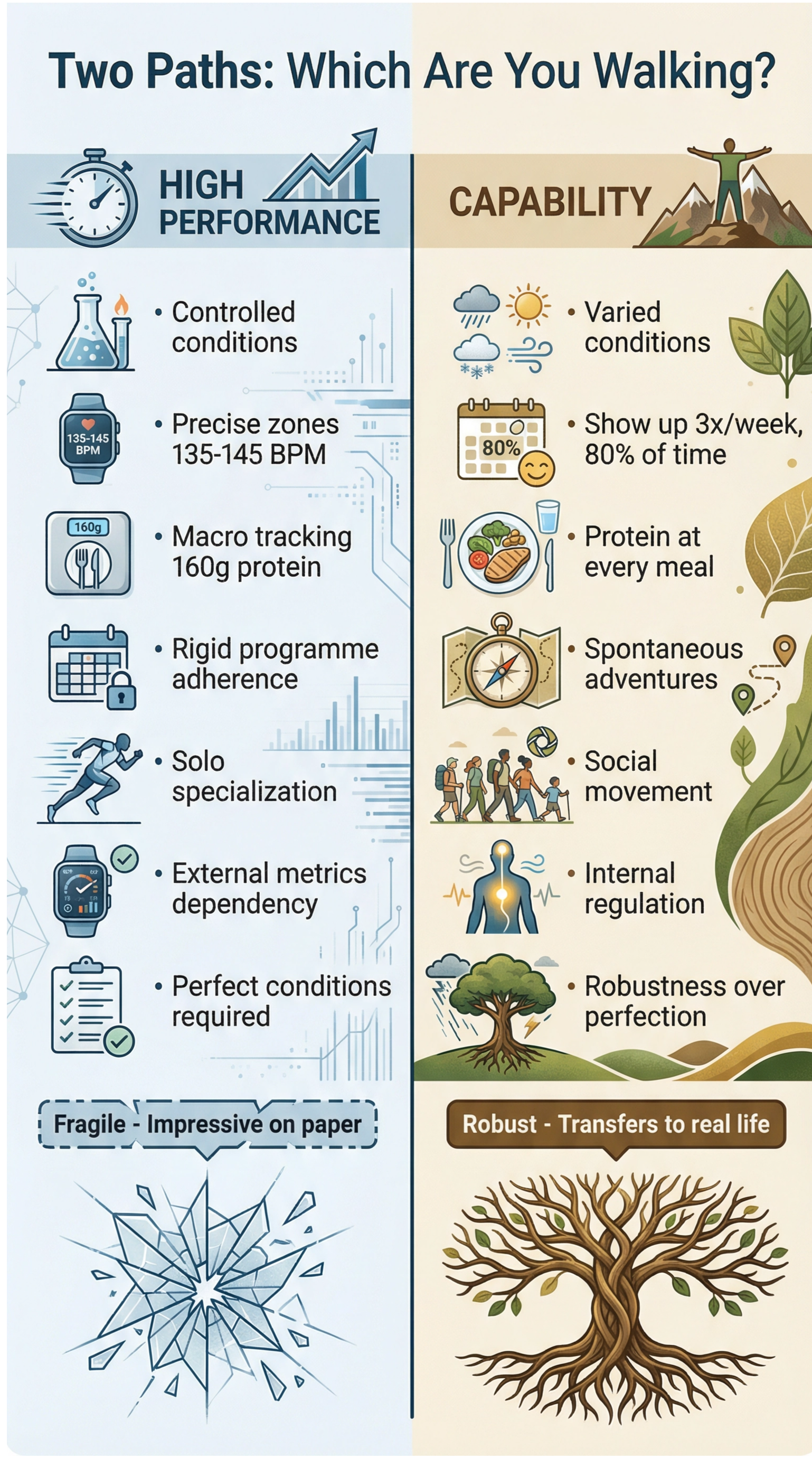
What Actually Happened to You
Think back to when you started following that "science-based" programme.
You were told:
Control all variables (same surface, same conditions, same fuelling)
Hit precise zones (Zone 2 at 135-145 BPM, no deviation)
Track macros religiously (160g protein, 250g carbs, timing matters)
Follow the plan exactly (no spontaneous deviation)
Specialise your training (if you're training for X, do X-specific work)
This all sounds reasonable. Scientific. Evidence-based.
And for the 19-year-old Olympic hopeful with 8-9 hours sleep, a nutritionist, and training as his full-time job? It works brilliantly.
But you're not that person.
You're a 32-year-old with two kids, a demanding job, and maybe 6 hours sleep on a good night. Your life is chaotic, not controlled. You need capability that transfers to real life, not performance that requires perfect conditions.
And high-performance protocols systematically removed every input that builds capability.
Here's what got taken from you:
What You Lost Without Realising It
The Ability to Perform When Conditions Aren't Perfect
High performance requires optimal conditions: well-rested, well-fuelled, low stress, good weather.
So you learned to only train when everything's dialled in.
Result? You can't show up when life's chaotic. Can't train on 5 hours sleep. Can't handle a session when you're stressed from work.
You built fragility, not robustness.
The capable guy trains anyway. Lighter intensity maybe, shorter duration, but he shows up. He's building confidence that he can perform under real-life constraints. Building the actual capability that transfers.
You're waiting for perfect conditions. Becoming passenger to circumstances rather than driver who acts regardless.
The Social Connection That Makes Movement Meaningful
High performance requires: training alone or with other specialists on strict schedules. Can't accommodate spontaneous group runs or adventures that don't fit the programme.
So you stopped doing the unplanned weekend hikes with mates. The spontaneous beach run with your kids. The tribal bonding that comes from shared physical effort.
Result? You train religiously but feel isolated.
Movement became a solo optimisation project instead of a shared human experience.
The guy with capability? He's training WITH people he cares about. Building pack mentality. Getting the dopamine and motivation that comes from moving together. The social dimension makes movement sustainable and meaningful.
You're hitting your prescribed zones. Alone. Following someone else's programme while life happens around you.
The Multi-Dimensional Role of Food
High performance requires: strict macro tracking. 250g carbs, 160g protein, precise timing. Food becomes fuel, nothing more.
So you started skipping family dinners because "I need to hit my macros." Missing your kid's face when they share a meal together. Losing food as bonding, as celebration, as experience.
Result? You fell out of love with nutrition entirely.
You optimised the joy out of eating.
The capable guy? Protein at every meal—simple guideline. But also: family dinners, social meals, feasts after accomplishments. Food as multi-dimensional experience, not just fuel.
You're tracking to the gram. Missing the moments. Building resentment towards something that should bring connection and pleasure.

The Ability to Move in Varied Ways
High performance requires: extreme specialisation. If you're optimising 400m time, you run 400m-specific intervals. Perfect form. Single plane. Repeated thousands of times.
So you stopped climbing, carrying, crawling, navigating varied terrain. Everything that built general movement capacity.
Result? You can run fast on a track but can't scramble up a hill carrying your kid without feeling like something's going to break.
You built specific performance. Lost general capability.
The capable guy? Running, carrying, climbing, varied terrain. Multi-planar movement. Reactive demands. Building robustness across contexts.
You're specialised in a single pattern. Fragile everywhere else.
The Internal Regulation Your Body Needs
High performance requires: external metrics for everything. Watch tells you effort level. App tells you if nutrition was right. Programme dictates when to train.
So you stopped developing interoception—your body's ability to sense and regulate its own internal state.
Result? Remove the watch and you're lost. You never learned to FEEL what Zone 2 is. You remained dependent on external validation.
Your capability to self-regulate atrophied.
The capable guy? Developed internal regulation. Knows by feel when to push, when to back off. Can adapt to varied conditions because he learned to listen to his body, not his device.
You're checking your watch every 30 seconds. Never building the internal capability that actually transfers to real life.
The Cruel Irony Nobody Mentions
You adopted these protocols thinking you were building capability.
You tracked everything. Followed the programme. Hit the zones. Logged the macros. Sacrificed spontaneity, social connection, family time, adventure—all in service of "doing it right."
And now you're frustrated because:
"I'm doing everything right—why do I feel like shit?"
"I'm more disciplined than ever—why do I feel like I'm missing out?"
"I'm fitter on paper—why do I feel less capable in real life?"
Because "everything right" for high performance systematically removed what creates human capability and fulfilment.
It's not that you're failing. It's that you're succeeding at the wrong thing.
You're building high performance when you needed capability.
And they're not the same thing.
The Research That Explains Why This Happens
This isn't just philosophy. The research shows exactly why precision destroys capability for most people.
Interoception Studies:
People with better interoceptive accuracy—the ability to sense their own internal state—naturally self-select sustainable pacing. They regulate exercise intensity appropriately. They know by feel when to push, when to back off.
But here's the key: external metric dependence prevents interoceptive development.
Every time you check your watch to tell you what effort level you're at, you're not learning to feel it yourself. You're outsourcing internal regulation to a device.
Result? You never develop the internal capability to self-regulate. You remain dependent. Remove the device and you're lost.
Self-Determination Theory:
Long-term adherence to exercise requires three things:
Autonomy (choice and self-direction)
Competence (feeling capable)
Relatedness (social connection)
High-performance protocols systematically remove all three:
No autonomy (programme dictates everything)
Reduced competence (constant feeling of "not hitting targets")
No relatedness (training alone on schedule)
Result? The precision that was supposed to optimise your results kills your consistency. You follow the programme perfectly for 8 weeks, then burn out completely because you've lost all intrinsic motivation.
The mechanism is clear:
External control → loss of autonomy → eroded interoception → worse self-regulation → more strain relative to capacity → injury or burnout → less long-term capability.
The tools that squeeze an extra 5-10% from an already-motivated athlete make a normal person quit in three weeks.

What Capability Actually Looks Like
The guy with capability doesn't look impressive on a spreadsheet.
He shows up 3x/week, 80% of the time, for months and years. Not perfect execution. Just showing up more often than not.
Knee felt dodgy at 3k? He tries 3.1k next time. Doesn't stop completely for six weeks. Builds volume through persistence, not by avoiding all discomfort.
Got 5 hours sleep? He trains anyway, maybe lighter. Stressed from work? Moves anyway. Shit weather? Goes anyway.
He's building robustness, not fragility.
He trains with mates. Spontaneous weekend adventures. Pack mentality. Shared physical effort that creates bonding solo optimal training never will.
He eats protein at every meal—simple guideline. But also enjoys family dinners, social meals, feasts after accomplishments. Food as multi-dimensional experience, not just fuel.
He follows inspiration. Unplanned beach run with kids. Weekend hike that wasn't programmed. The exploratory, playful element of movement that rigid plans destroy.
These variables create capability.
Not impressive on paper. But they transfer to real life.
When his kid says "Dad, can we climb that hill?" he doesn't say "it's not in my programme." He goes. Because he's capable.
When his mate texts "spontaneous beach run tomorrow?" he doesn't check his training plan to see if it conflicts with prescribed tempo session. He shows up. Because he's not fragile.
When he gets 5 hours sleep and has a stressful day, he doesn't wait for perfect conditions. He adapts. Because that's what capability is.
He can walk into a room and take up space. Handle whatever life throws at him. Be present with his kids. Not worry about his body breaking.
That's not on any spreadsheet. But it's what you actually wanted when you started training.
The Context Nobody's Explaining to You
There IS a hierarchy. But it's contextual, not universal.
For the 19-year-old Olympic hopeful:
Performance is the priority. Sacrifice everything else. Sleep 8-9 hours. Hit precise macros. Follow programme exactly. Control all variables.
That's appropriate for his context. He's trading capability for performance. Knowingly. Willingly.
For the 32-year-old dad with two kids:
Capability that transfers to real life. Presence with family (not sacrificed for training). Show up 3x/week even on 5 hours sleep. Protein at every meal (not 160g precision). Spontaneous adventure with kids (not rigid programme). Social connection through movement.
That's appropriate for HIS context. He needs capability, not 0.1% performance gains.
The problem:
Dad imports the 19-year-old's hierarchy.
Skips family dinner for macros. Can't do spontaneous hike because "not in programme." Needs perfect conditions to train. Creates fragility while thinking he's building capability.
He's succeeding at the wrong thing.
And the modern fitness world isn't helping. Influencers—whose entire life IS training and nutrition—post their protocols without context.
"This is what you need to do."
They're not lying. For THEM, at THEIR level, with THEIR goals and context, precision matters.
But they're promoting methods to people for whom those methods actively harm.
And people are susceptible to authority. When someone in great shape says "this is what you should do," they believe it.
The result?
Guys adopting high-performance protocols, thinking they're building capability, then feeling frustrated when they're "doing everything right" but feeling worse than ever.
Because the methods they adopted systematically removed what creates capability and fulfilment.
What You're Actually Building Towards
This isn't about ignoring science. It's about applying the right science to the right context.
Zone 2 training IS physiologically sound. Heart rate zones DO accelerate specific adaptations. Progressive overload DOES work.
None of this is wrong.
But precision carries hidden costs for people without athlete infrastructure:
Cognitive load of constantly checking pace/HR adds mental friction. More friction means lower adherence.
Identity shift from "a human who moves" to "a failing amateur athlete who isn't hitting numbers."
Shame and comparison when content from elite athletes sets standards that feel like failure.
The same tools that optimise an athlete destroy a normal person's consistency.
So the question isn't: "Does the science work?"
The question is: "What do I actually need?"
If you're a competitive athlete with performance goals, support infrastructure, and the time to dedicate—then yes, precision matters. Use the tools. Follow the protocols. Chase the marginal gains.
But if you're trying to build capability that transfers to real life—if you want to feel robust, present, alive, capable of handling whatever life throws at you—then you need different variables.
Variables that build multi-dimensional capability:
Consistency over time (show up 3x/week, 80% of the time, for months)
Don't catastrophise small things (knee dodgy at 3k? Try 3.1k next time, don't stop for six weeks)
Develop interoception (learn to listen to YOUR body's signals, not your watch's numbers)
Train under varied conditions (5 hours sleep? Train anyway. Stressed? Move anyway. Build robustness)
Multi-dimensional movement (run, carry, climb, crawl, varied terrain, not single-plane specialisation)
Social connection through movement (train with mates, spontaneous adventures, pack mentality)
Food as multi-dimensional experience (protein at every meal, but also bonding, celebration, pleasure)
Spontaneity and adventure (follow inspiration, unplanned challenges, exploratory movement)
These create capability. Robustness. The ability to handle real life.
Not impressive metrics. But transferable function.
The Choice You Need to Make
You can keep following protocols designed for people whose entire life is training.
Keep checking zones. Tracking macros to the gram. Skipping family moments for programme adherence. Building specific performance while your general capability collapses.
Keep feeling frustrated that you're "doing everything right" but something fundamental is missing.
Or you can recognise what you actually need.
You don't need to shave 0.1 seconds off your 400m. You need to carry your kid up a hill without anxiety. You need to show up on 5 hours sleep and still function. You need to handle spontaneous demands without your body breaking.
You need capability, not performance.
And capability requires different inputs.
Start Building What You Actually Need
The 10-Day ReWilding Challenge was designed specifically for this.
Not another performance protocol. Not more metrics to track. Not rigid programmes that remove spontaneity and social connection.
A 10-day evidence-based system to restore the capability modern training took from you.
Each day includes:
Training task that builds multi-dimensional capability (varied movement, natural terrain, reactive demands)
Mindset practice that develops interoception and internal regulation
Nutrition principle that makes food simple without optimising joy away
Plus lifetime access to:
Progressive training plans that build robustness, not fragility
Natural movement library (climbing, carrying, varied terrain)
Simple nutrition frameworks (not macro-tracking imprisonment)
Barefoot transition protocols
Cold exposure and recovery systems
Weekly planning templates that maintain spontaneity
For £7, you get the complete framework.
Not optimisation. Restoration.
Not performance metrics. Genuine capability.
Not rigid control. Multi-dimensional robustness.
By the end of 10 days:
You'll have improved nutrition without adding time to your week
You'll be moving differently—more mobile, athletic, alive
You'll have better planning and clarity without rigidity
You'll feel more capable, not more fragile
This is the alternative to treating your body like a spreadsheet.
The protocols designed for someone whose entire life is training? Let them have those.
You're building something different. Something that actually transfers to the life you're living.
Something that makes you feel capable across varied demands. Present with your family. Robust when conditions aren't perfect. Confident that your body can handle whatever comes.
That's capability. And it's what you actually wanted all along.
Start The 10-Day Challenge - £7
Stay Wild,
Luke

