
Built to Run Pt2
Built to Run — Part 2: Wake Up What You Already Have
If You're Here
You read Part 1.
You understand the philosophy: your body has incredible innate systems for endurance running. Every time you outsource those systems to devices and protocols, they atrophy.
You know the research: enjoyment predicts consistency, metrics create technostress, interoception develops through practise not through watches.
You've seen the evolutionary biology: nuchal ligament, Achilles tendon, Loop of Henle, breathing decoupling. Two million years of engineering already in your body.
Now you're asking: "How do I actually wake these systems up?"
This is that answer.
Not theory. Not philosophy. Practical activation.
The 8 Systems You're Not Using
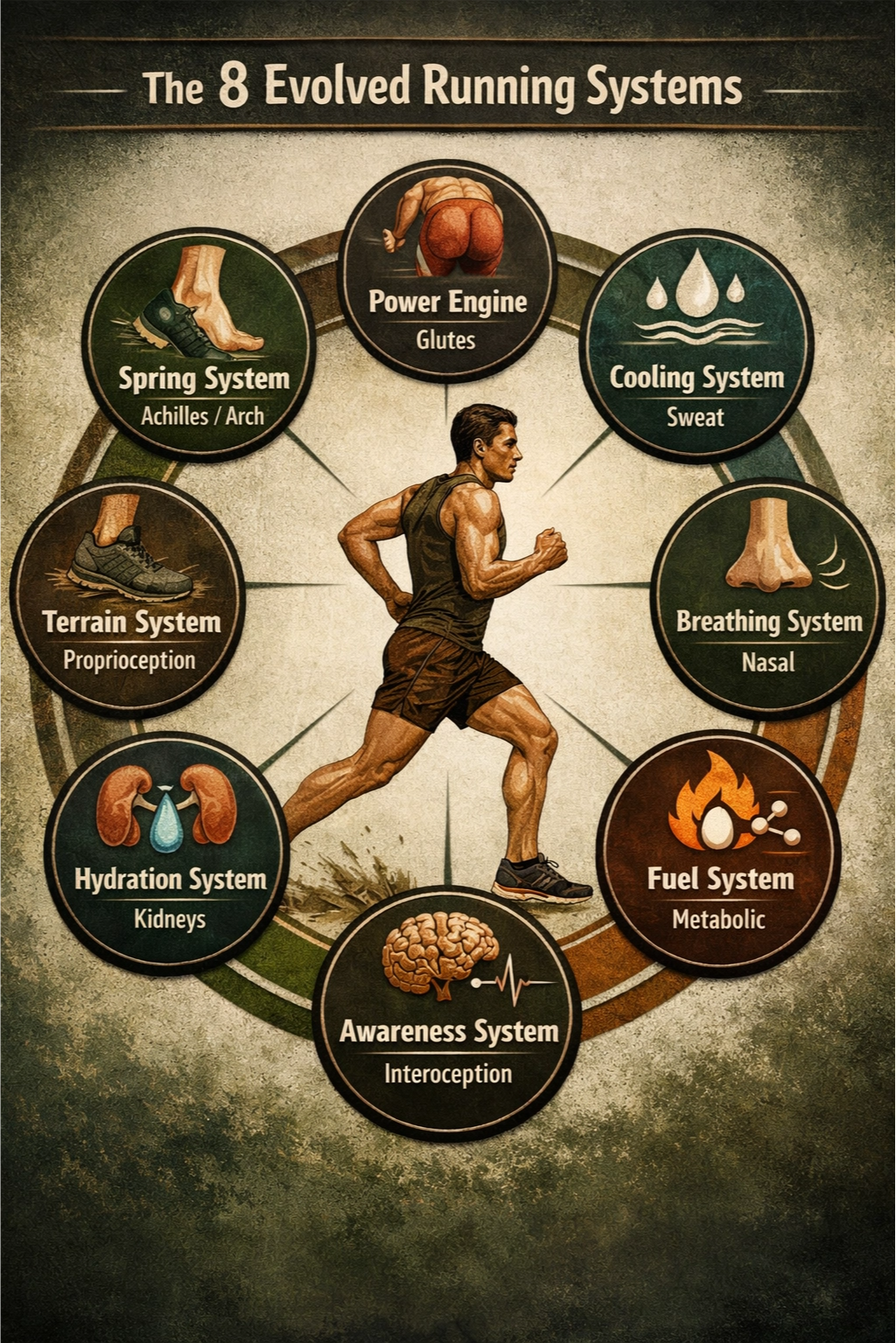
Your body has 8 evolved systems specifically designed for endurance running.
But having them and using them are two different things.
Here's what happens when you don't use them:
The Spring System (Achilles tendon & plantar arch) loses stiffness and energy return. Cushioned shoes do the work these structures evolved to do.
The Power Engine (gluteus maximus) shuts down from 8+ hours of sitting. You run with weak glutes and overworked quads.
The Cooling System (eccrine sweat glands) never gets challenged. Always training in air-conditioned environments means your thermoregulation atrophies.
The Breathing System (decoupled respiration) stays locked at mouth-breathing. You never develop the CO2 tolerance and breathing control that lets you pace by feel.
The Fuel System (metabolic flexibility) becomes carb-dependent. Always eating before runs means you never train fat oxidation enzymes.
The Awareness System (interoception) gets replaced by the watch. Checking data every 30 seconds means you never learn to read your own body.
The Hydration System (Loop of Henle) stops concentrating urine efficiently. Rigid hydration schedules override your thirst mechanism.
The Terrain System (proprioception) weakens from flat, predictable surfaces. Your 200,000 foot nerve endings aren't getting the feedback they evolved to process.
Use it or lose it. At the cellular level.
How to Actually Wake Them Up
Each system has specific activation protocols.
Not complex. Not time-consuming. But specific.
Let me show you one in full detail, then tease the rest so you understand the depth of what's possible.
The Spring System: Full Protocol (Your Taste of What's Inside)
Your Achilles tendon stores approximately 50% of your stride energy and releases it in the next step. Your plantar arch returns another 20%.
Together, they're a built-in energy recycling system that dramatically reduces the metabolic cost of running.
But cushioned shoes with thick soles and rigid arch support do the work these structures evolved to do.
Over time: tendon stiffness decreases, intrinsic foot muscles weaken, energy return diminishes.
The Daily Hopping Protocol
Backed by Engeroff et al. (2023, Scientific Reports).
Progressive daily hopping improved running economy by 2-4% in just 6 weeks. Zero injuries reported.
It takes 5 minutes per day:
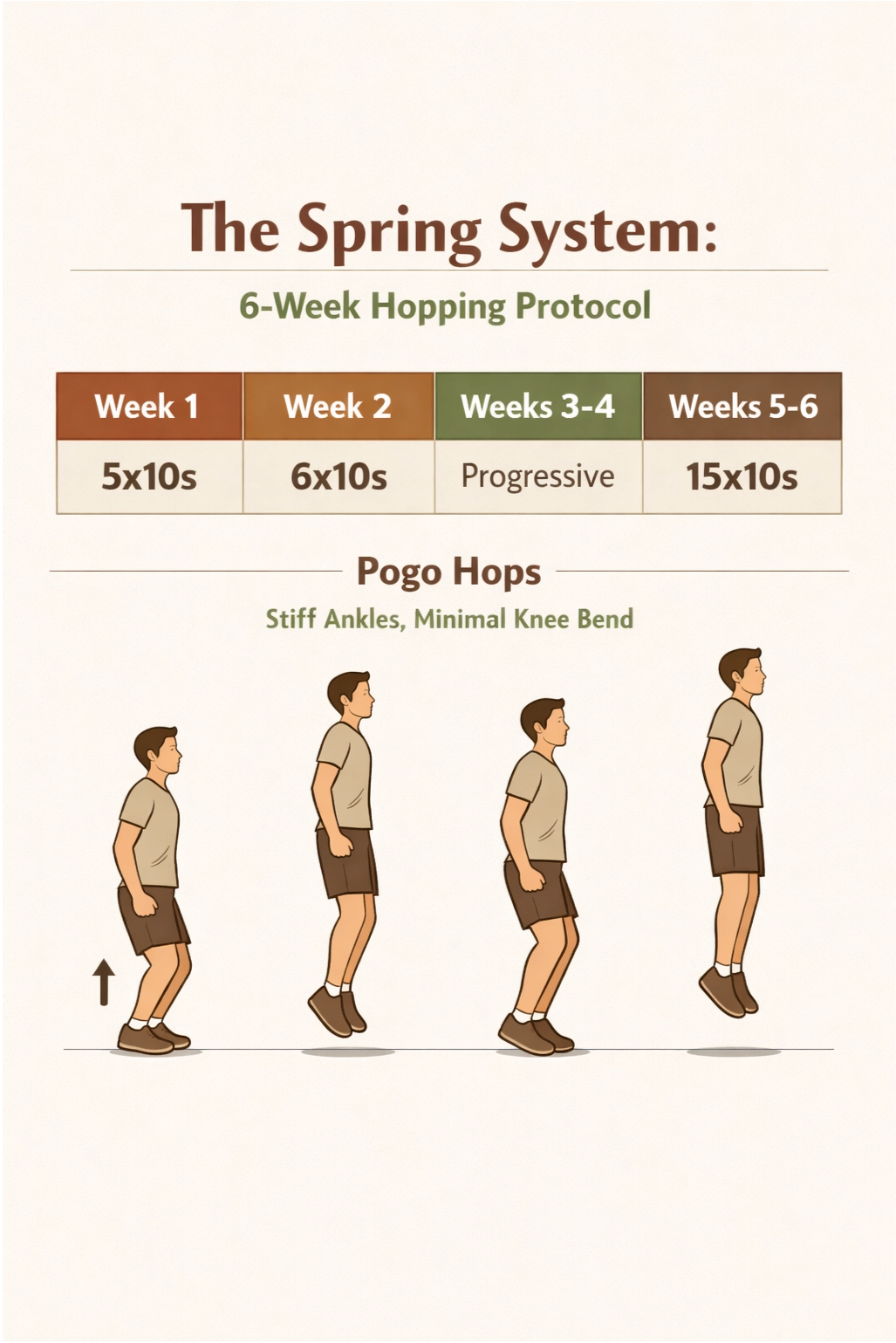
Week Sets × Duration Rest Between Sets 1 5 × 10 seconds 50 seconds 2 6 × 10 seconds 40 seconds 3-4 Progressive increase Progressive decrease 5-6 15 × 10 seconds 10 seconds
How to do it:
Hop on the spot, both feet hip-width apart, as high as possible, knees extended, minimise ground contact time.
Think "bouncing off the ground" not "jumping."
This trains the stretch-recoil mechanism directly.
But listen to your body. If your Achilles is sore — stop. If it doesn't feel right — back off. Achilles soreness is a signal, not something to push through.
The protocol is a guideline. Your body is the authority.
Additional Spring System Activations:
Pogo hops — stiff ankle, minimal knee bend, rapid ground contact. 3 × 20 before runs.
Barefoot grass walks — 5-10 minutes daily. Activates the 20+ intrinsic foot muscles that support the plantar arch.
Short foot exercise — dome the arch without curling toes. Hold 10 seconds × 10 reps. Builds the "foot core."
Toe yoga — lift big toe while pressing others down, then reverse. Develops independent toe control that feeds the windlass mechanism.
That's ONE system. Fully activated. Research-backed. Progressive protocol. Takes 5 minutes per day.
Now imagine having that level of detail for all 8 systems.
The Other 7 Systems (What You're Missing)
2. The Power Engine — Gluteus Maximus
The largest muscle in your body. Contracts powerfully during running but barely activates during walking.
It atrophies from: Sitting 8+ hours daily. Cushioned shoes encouraging heel-striking. Never running hills.
The activation includes:
Pre-run glute activation sequence (3-5 minutes, 3 specific movements)
Running cue that shifts load into glutes where it belongs
Hill sprint protocol that naturally forces maximal glute recruitment
Progressive intensity guidance
Why this matters: When glutes fire properly, your knees stop taking the beating. Your hamstrings stop cramping. Your running becomes powerful instead of shuffling.
3. The Cooling System — Eccrine Sweat Glands
The densest concentration of any mammal. This is why humans could persistence hunt — we ran in midday heat when prey animals overheated.
It atrophies from: Always training in air-conditioned gyms. Avoiding heat. Never challenging thermoregulation.
The activation includes:
7-10 day heat acclimation protocol
Post-run sauna progression (15-20 minutes, building from 10)
Adaptation monitoring (how to know it's working)
Research on increased blood plasma volume, improved sweat response, enhanced mitochondrial production
Why this matters: Better thermoregulation = longer runs in warmer conditions without bonking. Plus mitochondrial adaptations that improve performance even in cool weather.
4. The Breathing System — Decoupled Respiration
Quadrupedal mammals are locked at 1:1 stride-to-breath. Humans can breathe at 2:1, 3:1, 4:1, or no fixed coupling.
It atrophies from: Chronic mouth-breathing. Never practising breath control. Letting the watch dictate effort instead of reading breathing patterns.
The activation includes:
Nasal breathing progression (can be maintained up to 85% of VO2max)
The mouthful of water drill (forces nasal breathing adaptation)
Cadence breathing patterns (3:2 for easy, 2:1 for tempo)
Pre-run box breathing protocol
The test: can you run easy pace breathing only through your nose?
Why this matters: Breathing control = pacing control. Plus nitric oxide production, improved ventilatory efficiency, reduced exercise-induced bronchoconstriction.
5. The Fuel System — Metabolic Flexibility
Your body stores 1,200-2,000 calories of carbohydrates but enough fat to fuel 50-100 hours of continuous running.
It atrophies from: Eating before every run. Constant carbohydrate intake. Never training fasted.
The activation includes:
Cellular mechanism explanation (β-HAD enzyme upregulation, CPT1 suppression)
Fasted easy run protocol (when, how, progression)
Hard sessions fuelled strategy
Trail mix philosophy for long runs
Fuelling by duration guidelines
The metabolic flexibility test
Why this matters: Fat-adapted runners don't bonk. They can run for hours without needing constant fuel. The body learns to access its own massive energy stores.
6. The Awareness System — Interoception
Your body's ability to sense and regulate its own internal state.
It atrophies from: Checking your watch every 30 seconds. Following rigid pace prescriptions. Never running without data.
The activation includes:
The Body Scan Run protocol (systematic check-in every 10-15 minutes)
5-question Signal Check-In
HR Guessing Game (calibrating interoceptive accuracy)
Watch-free run requirements
Research showing better interoceptive accuracy = better pacing, better self-regulation
Why this matters: Internal regulation is the skill that makes you independent. Remove the watch and you still know exactly what you're doing.
7. The Hydration System — Loop of Henle
Your kidney's natural water conservation system. Concentrates urine when water is scarce, dilutes when abundant.
It atrophies from: Rigid hydration protocols. Drinking on schedule. Constant over-hydrating (more dangerous than mild dehydration).
The activation includes:
Drink to thirst protocol
What happens as the system adapts
Signal monitoring (thirst, mouth dryness, urine colour)
Why darker urine during exercise is normal and expected
The difference between efficient kidneys and chronic dehydration
Why this matters: Your thirst mechanism is highly evolved and remarkably accurate. Trust it and the Loop of Henle gets better at keeping fluid where you need it.
8. The Terrain System — Proprioception & Foot Intelligence
Your feet have over 200,000 nerve endings. They're designed to read terrain and adjust in real-time.
It atrophies from: Running exclusively on flat surfaces. Thick-soled shoes blocking feedback. Never challenging balance on uneven ground.
The activation includes:
Varied terrain progression (trails, grass, gravel, sand, rocky paths)
The boulder drill (sea walls, riverbeds, boulder fields)
Barefoot grass runs
Single-leg balance work
Rock hopping protocol
Why this matters: Foot intelligence makes you injury-resistant and agile. Your body learns to navigate complex terrain without thinking.
What You're Actually Getting
Each of those 8 systems has:
The cellular/anatomical mechanism (so you understand WHY)
How it atrophies (so you recognise what you've lost)
Complete activation protocols (progressive, research-backed)
Specific drills and timings
Adaptation monitoring (how to know it's working)
Integration with the other systems
This is The ReWilding System.
Not vague advice like "listen to your body."
Specific protocols. Progressive timelines. Research citations. The complete framework for waking up all 8 systems.
The Watch Paradox (How Data Fits In)
Once you've activated these systems and developed interoceptive accuracy, THEN data becomes useful.
The three phases:
Phase 1: No Watch (First 2-3 Months)
Build interoceptive accuracy first. Learn to read effort by feel.
No external validation. Just you and your body.
Phase 2: Watch as Confirmation (Months 3-6)
Wear the watch occasionally. Check it to confirm what you're already feeling.
"This feels like moderate effort... yep, HR confirms, I'm in Zone 3"
Your body is still the primary signal. The watch confirms or provides context.
Phase 3: Watch as Advisor (Advanced)
Now you can integrate data actively.
Scenario: Bounding Downhill
20 miles into a mountain run. Technical descent. Feel amazing. Glance at watch: HR elevated.
Decision: If racing for placement → conserve. If training run exploring capability → bound down it.
The watch gave information. You made the decision based on context.
This relationship only works after you've developed interoceptive accuracy through art-first running.
If you skip straight to watch-dependent training, you never build the internal regulation that makes data useful rather than controlling.
Simple Fuelling (The Trail Mix Philosophy)
Your body's energy regulation systems work. You don't need to calculate grams of carbohydrate per hour.
The principle: adequacy, not optimisation.
What Goes In the Trail Mix:
Dried fruit (dates, raisins, apricots). Nuts (almonds, cashews). Seeds (pumpkin, sunflower, chia). Crushed biscuits. Maybe some sweets. Coconut flakes. Pink Himalayan sea salt.
My favourite: Medjool date rolled in chia seeds and Himalayan sea salt.
The bag adapts throughout the week. Whatever's in the cupboards.
Fuelling By Duration:
Run Duration What to Bring Approach Under 60 min Water or nothing Trust your body 60-90 min Water Drink when thirsty 90 min - 3 hours Water + trail mix Eat when hungry 3+ hours Water + trail mix + real food Regular handfuls, maybe coffee on a mountain
Eat when hungry. Drink when thirsty. Your body will tell you what it needs.
The Running Vest System
I have a vest that hangs by my door, ready to go.
Always in there:
Foldable roll mat
Seal skins gloves
Warm top, waterproofed
Emergency bivvy bag
500ml bottle (always filled)
Trail mix bag (topped up weekly)
Dog poo bags and biscuits
Small first aid kit
Emergency ration
This removes decision fatigue.
When today's the planned long run and work finishes early? Vest on. Out the door.
It removes friction to the hard thing. But doesn't remove the hardness itself.
You still run in the cold. Still cover the distance. Still navigate terrain.
The friction removal serves the challenge. It doesn't replace it.
Reading Your Body's Signals (Sore vs. Injured)
"Listen to your body" is useless without knowing what to listen for.
Here's the distinction:
Sore = Normal Adaptation
Dull, diffuse ache across muscle group
Both sides relatively equal
Eases with gentle movement
Gets better after warm-up
You can run without compensating
Injured = Tissue Damage
Sharp, specific pain
Usually one-sided
Gets worse with continued movement
Makes you limp or alter gait
You compensate to avoid the pain
When Something Feels Dodgy:
Don't catastrophise and stop for 6 weeks. But don't ignore signals.
Try this progression:
Back off intensity (walk, see if it eases)
If it eases, resume running at easier pace
If it persists but doesn't worsen, finish shorter
If it worsens, stop and walk home
Next run:
Try again at easier effort
If issue returns immediately → injury signal, take few days off
If it doesn't return → probably fatigue or minor niggle
Build the skill of distinguishing normal discomfort from injury warnings.
What This Looks Like in Practice
A Real Week from My Life:
Monday: Easy 6-miler with the dog. No watch. Trail mix in vest. Just moving.
Tuesday: Strength session. Heavy squats, deadlifts, carries. Building robustness.
Wednesday: Hills. Ran to local trail, smashed some hill reps (by feel), enjoyed downhills. Watch on, checked HR a few times.
Thursday: Rest day. Walked the dog. Stretched. Mobility work.
Friday: Easy 8-miler. Legs felt heavy from hills, kept it comfortable.
Saturday: Long run. 20 miles in mountains. Vest packed the night before. Work finished early, out the door. Trail mix, water, coffee at summit. Checked watch occasionally. Bounded down technical descents when it felt amazing. Felt fucking alive.
Sunday: Recovery walk with family.
Weekly total: ~40 miles, 2 strength sessions, 1 rest day.
Structure? Yes. Rigid plan? No. Enjoyment? Absolutely.
That's the integration.
The Challenge (Start Simple)
Next long run — try this:
Leave the watch at home.
Pack the vest: trail mix, water, maybe coffee setup.
Head out with no prescribed pace, no target time, no fuelling schedule.
Just go.
Run by feel. Change pace with terrain. Sprint down a hill if it looks amazing. Walk when you need to. Eat when hungry. Drink when thirsty.
Notice:
How much effort this feels like
Whether legs feel springy or heavy
When genuine hunger arrives
What thirst actually feels like
Moments when you're completely absorbed
The difference between "this is hard" and "this hurts"
After the run, ask yourself:
Did I enjoy that more than following zones and protocols?
Did my body tell me useful information?
Could I do that again?
Do I want to?
If the answers are yes — you've just discovered what your body has been trying to tell you all along.
Ready to Wake Up All 8 Systems?
You've seen the philosophy (Part 1).
You've got a taste of the protocols (the Spring System hopping progression).
You understand there are 7 more systems with the same level of detail.
Now it's time to actually activate them all.
The ReWilding System gives you everything:
Complete protocols for all 8 systems:
Spring System (Achilles & plantar arch)
Power Engine (gluteus maximus)
Cooling System (sweat glands)
Breathing System (decoupled respiration)
Fuel System (metabolic flexibility)
Awareness System (interoception)
Hydration System (Loop of Henle)
Terrain System (proprioception)
Each system includes:
Complete cellular/anatomical explanation
Progressive activation protocols
Specific drills with timings
Research backing
Integration guidance
Plus:
16-week progressive training plans (art-first approach)
Mountain running preparation
Natural movement library
Barefoot transition protocols
Weekly planning templates
30-day challenges
Plus the complete ReWilding framework:
Easy eating principles
Mindset and identity work
Integration into real life (kids, job, commitments)
£97/year for the next 4 people. Once they've gone... £197/year.
This isn't another training plan. It's the complete system for waking up what you already have.
Join The ReWilding System - £97/year
The Truth About What You're Building
This isn't about running faster.
It's about reconnecting with the innate capabilities your body already has.
The nuchal ligament stabilises your head.
The Achilles tendon recycles energy.
The Loop of Henle regulates hydration.
Your interoceptive systems read effort and energy.
These systems work. They've worked for 2 million years.
But they only work if you let them.
The Spring System hopping protocol you just learned? That's one activation out of eight.
The breathing drills, the metabolic flexibility training, the proprioception work, the glute activation, the interoception development — they're all waiting for you.
Complete protocols. Progressive timelines. Research-backed.
The ReWilding System is how you wake them all up.
£97/year for the next 4 people.
Then £197/year.
Your body already knows how to do this. Stop replacing its systems. Start activating them.
Let's hunt.
— Luke, EverWild
Join The ReWilding System - £97/year
P.S. Drop me a message on the gram, me you have joined from this blog - and I'll put together a personalised phased nutrition protocol geared towards your goals.

