
Built To Run
Built to Run — Part 1: The Art of the Long Run
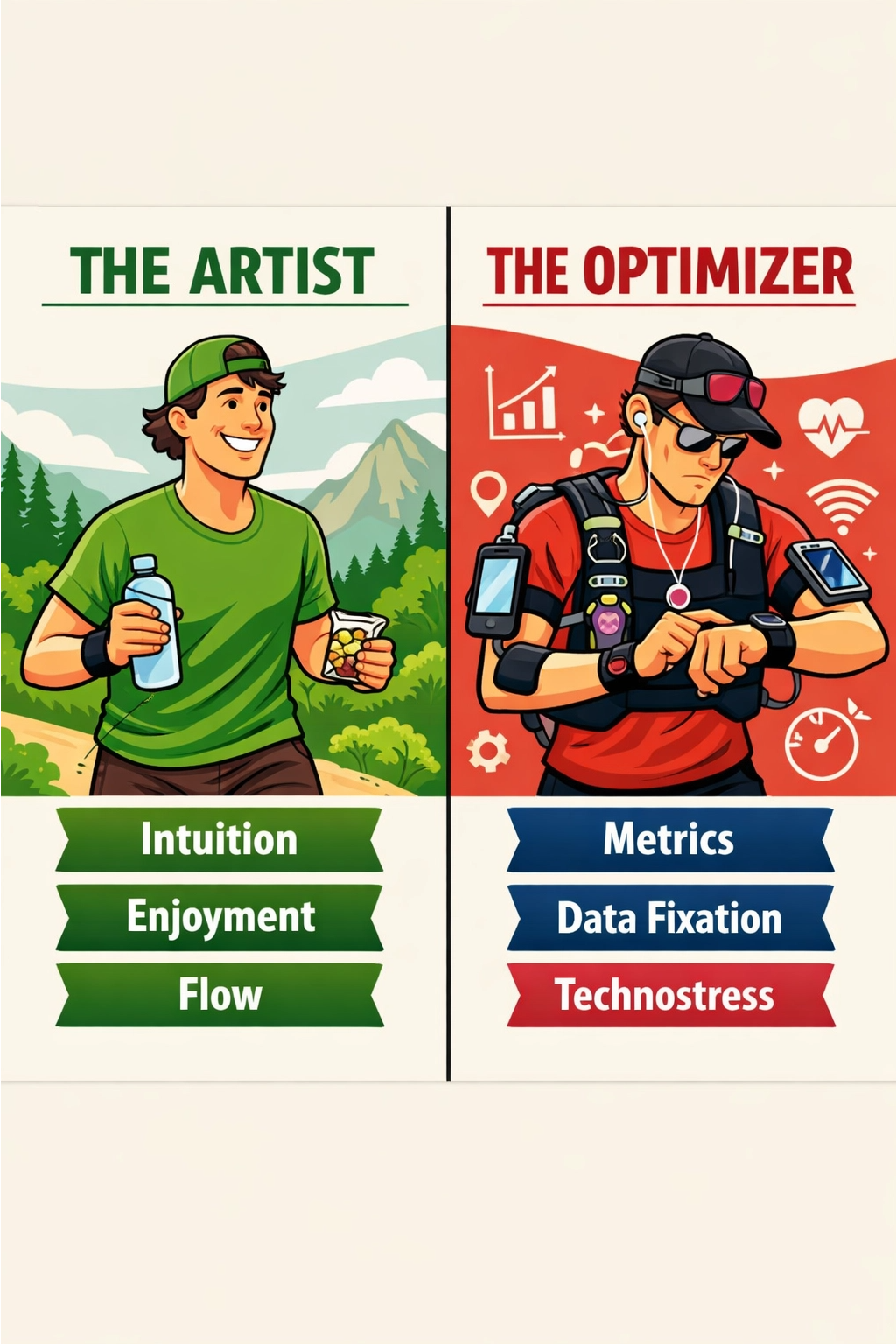
Two Runners
Picture two runners heading out for a long run.
Runner One:
Grabs a couple handfuls of trail mix. Fills a bottle with water. Maybe throws in a coffee setup because fuck it, brewing coffee on a mountain sounds amazing. Laces up the shoes. Heads out the door.
Runs by feel. Changes pace depending on terrain. Sprints down a hill because it feels fucking incredible. Bounding from rock to rock. Finishes. Enjoys a beer. Reflects on what a great run it was.
Runner Two:
Spent 48 hours carb-loading with precise macros. Sets watch to specific heart rate zones. Follows prescribed pace targets. Fuels with exact carbohydrate mix at calculated intervals. Definitely doesn't sprint down a downhill—that would take him out of Zone 2.
Finishes. Opens smart watch app. Dissects heart rate zones. Conducts thorough cool-down. Fuels with correct carb-to-protein ratio.
Here's the question nobody's asking:
Which runner are you trying to be?
And more importantly: which runner do you actually want to be?
What This Is Really About
This isn't a blog about running better.
It's about how to stop outsourcing your body's innate capabilities to devices and systems that make you dependent.
There's a quote I keep coming back to:
"What a shame it is to grow old and not realise the beauty and the strength of which the body is capable."
We can erode this capability in two ways:
By not training at all
By outsourcing everything to devices and "optimising" away the very systems that make us capable
Most people focus on the first problem. I'm here to talk about the second.
Because here's what nobody tells you: Every time you outsource a capability to a device, that capability atrophies.
The watch doesn't just track your effort—it replaces your ability to read your own body.
The fuelling protocol doesn't optimise your energy—it overrides your body's natural regulation systems.
The training plan doesn't build capability—it replaces interoception with external authority.
And running is just where this shows up most obviously.
How I Learned This (The Hard Way)
I was injury-prone from the age of 12.
My dad coached me. I engaged with it to please him, if I'm honest. And it worked—I won basically fucking everything. School sports day in Year 6? Won every single race from the sprints to the long distance. I was running close to national level by 14. I played rugby at Twickenham in the school national championships.
But I was constantly broken.
Hip niggles. Knee niggles. Horrific shin splints. I'd had a prominent hip problem as a kid around age 5 or 6—had interventions, spent periods where I had to stay still. I remember being so desperate to move and play that I ended up playing with my sister's Polly Pocket, thinking "this is for girls, I don't even like this stuff, but here we are."
The intense training continued through my teens. Looking back now, the programme was causing the injuries. Massive overload. Too much volume. Running form wasn't great. Overall lower limb weakness. One-dimensional strengthening exercises that didn't go anywhere near deep enough.
I remember my dad getting me to do a plyometric session once. I had to take two days off school because I couldn't actually walk.
But I kept going because that's what you do when you're chasing performance.
Then I joined the Royal Marines.
Still getting shin splints. Still pushing through because if you want the green beret, you push through. I remember being told to double mark time outside the gymnasium—that's jogging on the spot with knees up high. One leg was coming up. The other was just slightly off the floor, barely moving. I was fucked. Like I actually looked physically lame.
At what point do you start questioning whether the approach is wrong, not just your body?
The Transformation
I read Born to Run. It resonated.
I switched to minimalist running.
I admittedly overdid it initially—went straight to a 4-mile run when the transition is meant to be slow and steady. Had the worst delayed onset muscle soreness in my soleus I've ever had. But I got away with it.
And then everything changed.
The movement felt intuitive. Smooth. Graceful.
I felt springier. More connected. The muscle soreness hit places I'd never experienced before—in a good way. My body was finally being used as designed.
I explored this through different footwear—completely barefoot, sandals, transition shoes, minimalist shoes. Tried different terrains—grass, tarmac, mountains.
I just loved it.
I'm 37 now. I can still run and sprint and jump for no reason other than I want to. I can bound over large uneven boulders, feeling my way across them. I put a lot of this down to the minimalist foundation—being able to feel my movement, connect with the ground.
It's bloody awesome.
But here's what I realised: it wasn't just about the footwear.
The footwear was the gateway to something bigger—reconnecting with intuitive movement instead of following external prescriptions.
The Sauna Story
I was in a sauna recently and overheard a runner talking about how he'd improved his running using a specific threshold method.
At the end of every run, he would finger-prick himself to test blood lactate levels. This ensured he got the intensity exactly right and could monitor changes in where his threshold sat.
It worked incredibly well for him.
Other people in the sauna said it sounded great. Maybe that's what they needed to do to improve their running.
Then I talked to this guy in more detail.
He was running 2 hour 20 minute marathons.
Actual high-performance, sub-elite running.
The guy he was talking to? Couldn't run 26.2 miles yet.
The last thing that second person needs is to get bogged down in lactate threshold testing.
He needs to enjoy running enough to keep showing up.
And here's the thing about the 2:20 marathoner—all he wanted to do was talk about himself. You could tell some people liked listening, but some people just wanted him to shut the fuck up. It was pure ego.
Could he benefit from the art of running? Maybe not to improve his marathon time. But to become a better human being? Absolutely.
We're Already Built For This
Here's what most people don't realise:
The human body is designed for endurance running.
Not metaphorically. Not "kind of." From the ground up.
In 2004, Bramble and Lieberman published a landmark paper in Nature identifying 26 anatomical traits that enhance running ability in humans. They concluded that endurance running capability emerged around 2 million years ago in Homo erectus and that "running has substantially shaped human evolution."
Bramble's quote: "Running made us human—at least in an anatomical sense."
Let me show you what I mean:
The Nuchal Ligament
This is an elastic band connecting the base of your skull to your neck. It stabilises your head during running.
Evolved specifically in animals that run. Apes don't have it.
Your head stays stable so you can navigate terrain while bounding over rocks at speed.
The Achilles Tendon
Longest in the animal kingdom. Stores approximately 50% of your stride energy and releases it in the next step.
This dramatically reduces the metabolic cost of running. Your body recycles energy automatically with every stride.
Recent research (Blazevich & Fletcher, 2023) showed the long Achilles tendon doesn't just save energy—it reduces neuromotor fatigue and the subjective sense of effort, allowing humans to "choose to move at faster speeds for longer."
Your body already has a built-in energy return system. You don't need to optimize it. You need to let it work.
Breathing Decoupling
Quadrupedal mammals are locked at 1:1 stride-to-breath ratio when galloping. Their guts slam into their diaphragm with every stride.
Humans can breathe at 2:1, 3:1, 4:1, or no fixed coupling at all.
We can regulate breathing independently of stride—a massive advantage for sustained aerobic effort.
Sweat Glands
We have the densest concentration of eccrine sweat glands of any mammal. This is our primary thermoregulation system.
We cool ourselves through evaporation, not panting. This lets us run in heat when other animals overheat.
Combined with reduced body hair and elongated body shape, humans are the best-cooled runners on the planet.
The Loop of Henle
This is your kidney's natural water conservation and concentration system. It regulates hydration and can concentrate urine without you needing to follow rigid hydration protocols.
Your body already has a sophisticated hydration regulation system.
Gluteus Maximus
This muscle contracts during running but nowhere near the same level during walking.
It's essentially a running muscle. It stabilizes the trunk and powers forward propulsion.
The reason you can get one hell of a burn in the glutes, and seemingly just keep pushing (KB challenge, for those that took part) that's because the glutes have such a fantastic blood supply.
The Plantar Arch
Returns approximately 20% of energy during the weight-loading phase of each stride.
Another energy-recycling mechanism built into your foot.
(As long as this function is trained)

Here's my point:
Your body has incredible systems that evolved over 2 million years specifically for endurance running.
The nuchal ligament stabilises your head.
The Achilles tendon recycles energy.
The plantar arch springs you forward.
The Loop of Henle regulates hydration.
Your breathing decouples from stride.
Your sweat glands cool you in heat.
These systems work. They're already there. They're incredibly sophisticated.
But here's what happens when you outsource everything:
Check your watch every 30 seconds → your interoceptive ability to read effort atrophies
Follow rigid fuelling protocols → your body's natural hunger and thirst regulation systems get overridden
Rely on heart rate zones to tell you intensity → you never learn to feel what Zone 2 is
Use it or lose it.
The systems don't just sit dormant. They actually degrade when you don't let them function.
The Art Removes Ego
There's something profound that happens when you approach running as art instead of science.
You remove the ego.
Runner Two (the one with the carb protocols and heart rate zones) is chasing something external. A time. A metric. Proof of something.
Runner One (the one with trail mix and water) is just... being with the body. Enjoying movement. Connecting with what the body can do.
When I'm 20 miles into a long mountain run and I hit a technical descent that looks amazing—I bound down it. Not because it's "optimal training stimulus." Not because it's in the plan.
Because it feels fucking incredible.
I'm 37 years old and I still move like the kid who wanted to build dams in streams and climb trees. That's what I'm after.
Not hitting times. Not optimising. Not proving anything.
Just the beauty and strength of which the body is capable.
Why This Actually Matters (The Research)
This isn't just philosophy. The research backs up why the "art first" approach works better for most people.
Enjoyment → Consistency → Capability
Rodrigues et al. (2022) found that exercise enjoyment positively predicted exercise habit, intention to continue exercising, and exercise frequency—all at p < 0.001.
Enjoyment was the strongest single predictor of long-term exercise behaviour.
Schneider & Kwan (2013) documented that approximately 50% of people drop out of exercise programmes within the first 6 months. Promoting positive affective responses during exercise significantly increases adherence.
Translation: If you don't enjoy it, you won't stick with it. And if you don't stick with it, none of the "optimisation" matters.
The Problem With Metrics
Whelan et al. (2024) studied performance-oriented amateur athletes and identified 16 technostress factors from self-tracking in sport.
The highest code count (113 instances): Measurement data fixation.
Obsessive focus on metrics that alters training behaviour and overrides bodily signals.
Documented downstream effects included: "reduced enjoyment of movement" and "loss of intuitive body awareness."
The watch doesn't just fail to improve your running. It actively erodes your ability to self-regulate.
Interoception: The Skill You're Not Building
Interoception is your body's ability to sense and regulate its own internal state.
Research shows that people with better interoceptive accuracy naturally self-select sustainable pacing. They regulate exercise intensity appropriately. They know by feel when to push, when to back off.
But here's the key: external metric dependence prevents interoceptive development.
Every time you check your watch to tell you what effort level you're at, you're not learning to feel it yourself. You're outsourcing internal regulation to a device.
Result? You never develop the internal capability to self-regulate. You remain dependent.
Remove the device and you're lost.
Flow State: What You're Actually Chasing
Flow is a state of complete absorption characterised by loss of self-awareness and distorted time perception.
During flow, the prefrontal cortex quiets—reducing self-criticism and allowing movement to become automatic.
Flow is particularly common during endurance-building miles when there's a balance between challenge and skill.
But here's the problem:
Constantly checking a watch re-engages the prefrontal cortex and pulls you out of flow.
The intuitive approach—adjusting pace to terrain and feeling, sprinting downhill because it feels amazing, backing off when the body says so—naturally creates the conditions for flow.
The Nuance Nobody Mentions
Here's what I'm NOT saying:
I'm not saying "never use structure."
I'm not saying "load management doesn't matter."
I'm not saying "just go run 20 miles because natural systems."
If you've only ever run 3 miles before, you can't suddenly run 20 miles just because you approach it as art.
Progressive overload still matters. Load management is key.
But here's the distinction:
You can build from 3 miles → 6 miles → 10 miles → 15 miles → 20 miles through:
Option A: Science Approach
Prescribed paces and heart rate zones
Rigid training plan
Exact fuelling protocols
Catastrophising when something feels off (stop completely for 6 weeks)
Option B: Art Approach
Running for joy, not hitting prescribed paces
Listening to your body's signals
Backing off when something feels wrong, not catastrophising
Building through consistency (showing up 3x/week, 80% of the time)
Simple fuelling (trail mix, water)
Varied terrain (teaches proprioception)
The art doesn't replace load management. The art IS intelligent load management through interoception rather than through spreadsheets.
What About the Watch?
I often do take a watch with me. I do track zones.
But I don't use it to tell me what to do.
Here's the difference:
Using the watch to "tell you what to do":
Check watch every 30 seconds
"I need to stay in Zone 2, so I'm slowing down even though my body feels great"
"My HR is elevated, so I must be working too hard" (ignoring heat, terrain, altitude)
The watch is the BOSS, your body is the SUBORDINATE
Using the watch as "objective feedback":
Check watch occasionally
"My HR is lower than usual at this pace—I'm getting fitter"
"My HR is elevated but I feel fine—probably the heat/terrain"
"I feel like I'm pushing too hard, let me check... yep, HR confirms, I'll back off"
Your body is the BOSS, the watch is the ADVISOR
Example:
I'm 20 miles into a long mountain run. I hit a steep technical descent. I feel amazing and want to bound down it. I glance at my watch and see my HR is elevated.
What do I do?
If I'm in a race and wanting to place well (performance context): I might slow down and conserve.
If I'm out with the dog having a great time (art context): I bound down it. Because this is a perfect opportunity to explore what my body can do.
The watch gives me information. I make the decision based on context.
This is the nuance most people miss. The watch isn't evil. The relationship with the watch is the problem.
But you can only have this relationship with the watch AFTER you've developed interoceptive accuracy. After you've learned to read your body.
Art first. Then you can integrate data without being controlled by it.
The Running Vest System
I have a running vest that hangs by the door, ready to go.
Always in there:
Foldable roll mat
Seal skins gloves
Warm top, waterproofed
Emergency ration
500ml bottle
Dog poo bags and dog biscuits (I run with my dog)
Trail mix bag
Small first aid kit
Emergency bivvy bag
The trail mix:
This adapts to what's in the cupboards.
Dried fruit. Nuts. Seeds. Crushed biscuits from the biscuit tin. Maybe some sweets. Dates. Coconut. Pink Himalayan sea salt.
My favourite: Medjool date rolled in chia seeds and Himalayan sea salt. Tastes amazing and gives great fuel and energy.
This isn't "optimised nutrition protocol." This is: whatever's in the cupboards that will give me energy, I enjoy, and allows the bodies systems to work in the way they evolved.
The vest being ready doesn't mean I can just abandon my kids and go run 30 miles whenever inspiration strikes. I'm living real life. I have commitments. I have children.
But it does mean: when today's the planned long run day and work finishes early?
Vest on. Out the door.
No packing. No decisions. No friction.
This is the "remove friction to the hard thing" principle. The friction removal serves the challenge, doesn't replace it.
What This Means For You
Next time you plan a long run, try this:
Leave the watch at home.
Grab some trail mix. Fill a water bottle. Maybe pack a coffee setup if that sounds fun.
Head out.
Run by feel. Change pace depending on terrain. If you hit a hill that looks amazing, sprint down it. If your body says back off, back off.
Just be with your body. Let the innate systems do their work.
See what it feels like to:
Not check external validation every 30 seconds
Trust your body's signals
Enjoy movement without metrics
Remember what it felt like to run as a kid
Not to hit a time. Not to optimize. Not to prove anything.
Just to connect with the beauty and strength of which your body is capable.
Because here's what nobody tells you:
Your body already knows how to do this.
The nuchal ligament stabilises your head.
The Achilles tendon recycles energy.
The Loop of Henle regulates hydration.
Your interoceptive systems can read effort.
You don't need to optimise these systems. You need to stop replacing them.
What's Next
This is Part 1—the philosophy, the story, the why.
Part 2 will be the practical guide:
How to actually fuel simply (the trail mix system)
How to read your body's signals (not just "listen to your body")
The progressive development model (building to big challenges through art)
When and how structure enters (the Wild Ultra approach)
How to use data as information, not instruction
But for now, just sit with this:
What would it feel like to approach your next long run as art, not science?
What would it feel like to trust your body instead of outsourcing to devices?
What would it feel like to run the way you're built to run?

