
Why Your Brain Fights What Your Body Needs (And What To Do About It)
You know you should go for that run. The trainers are by the door. The weather's actually decent. You've got time.
But you don't go.
Instead, you answer three more emails. Check Slack "just quickly." Scroll LinkedIn. Then it's too late, too dark, and you're too tired.
Tomorrow, you tell yourself. Tomorrow I'll definitely go.
This isn't laziness. This isn't lack of discipline. This is your brain doing exactly what 200,000 years of evolution trained it to do: keep you alive with minimal energy expenditure.
The problem? Your brain's survival manual was written for a world that no longer exists.
The Brain That Kept Your Ancestors Alive Is Killing You Slowly
Modern neuroscience has moved beyond the oversimplified "three brains" model—reptilian, emotional, logical—but the core insight remains true: your brain is a prediction machine optimised for survival in environments of scarcity and danger.
When your ancestors faced a threat, the response was immediate and physical. Lion appears. Heart rate spikes. Fight or flee. Threat resolved. System returns to baseline. This is acute stress—the kind your brain evolved to handle brilliantly.
Fast forward to now. You wake up to 47 emails. Three are passive-aggressive. One is from your boss with "quick question" in the subject line (never quick). Your calendar has back-to-back meetings. Your phone buzzes with a client issue. Your kids need packed lunches. The mortgage payment is processing.
No lions. But your brain's threat-detection system is screaming just the same.
Except this time, there's no resolution. The emails keep coming. The Slack messages never stop. The to-do list regenerates faster than you can complete it. This is chronic stress—the kind your brain has no evolutionary template for managing.
Your ancestors experienced stress in bounded episodes with clear endpoints. Modern life delivers stress as an ambient, unresolvable background hum that never switches off.
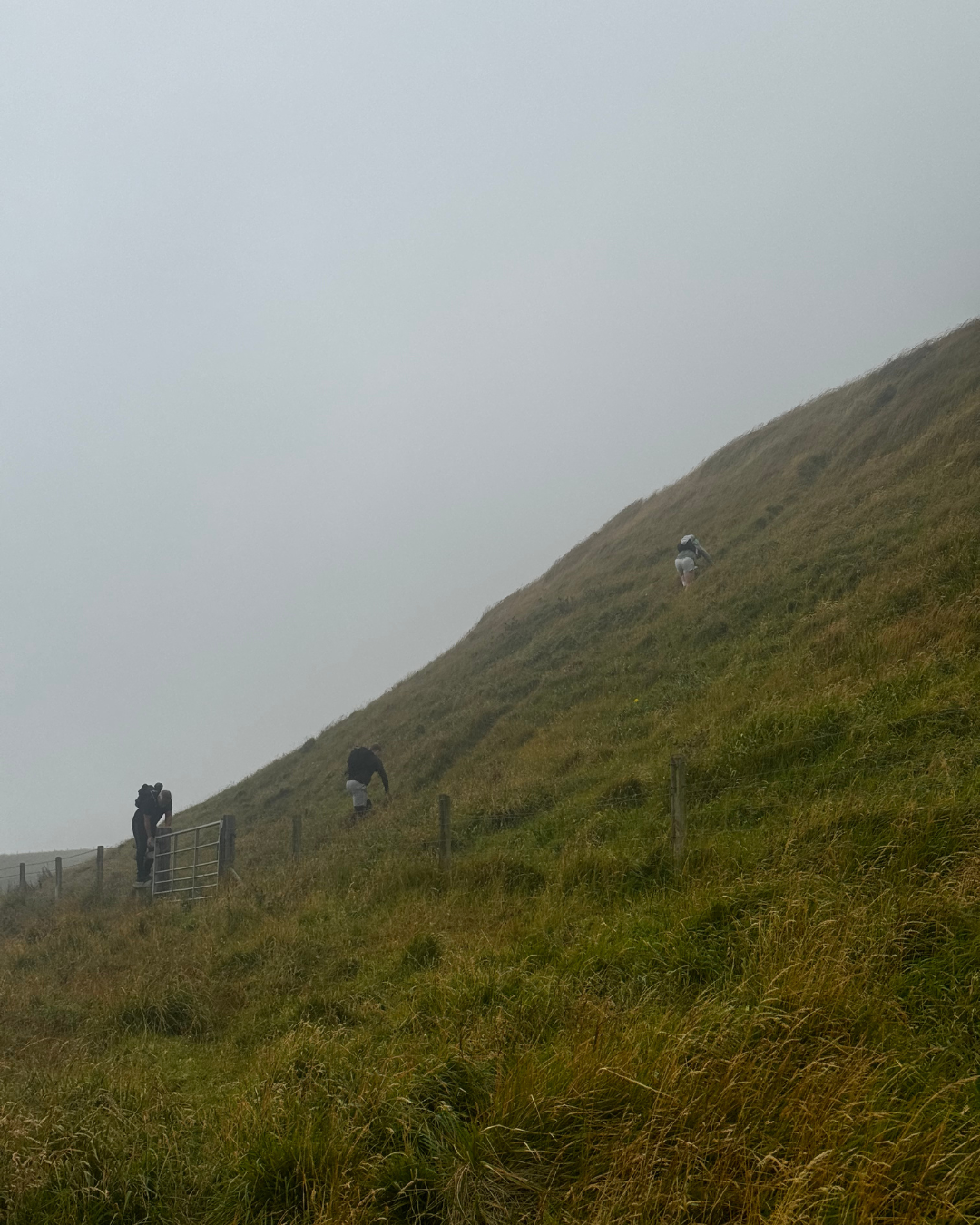
The Comfort Trap: When Safety Becomes Suffocation
Here's the cruel irony: you've achieved what your ancestors would consider paradise. Climate-controlled home. Abundant food. No predators. Physical safety guaranteed.
Yet you feel foggy. Stuck. Like you're slowly disappearing into routine.
Because while modern comfort solved the scarcity problems your brain evolved to navigate, it created a new problem your brain has no mechanism to handle: the complete absence of acute, resolvable physical challenge.
Your body was designed to:
Track prey for hours across varied terrain
Climb to obtain food
Endure cold nights and scorching days
Carry heavy loads back to camp
Sprint from genuine danger
These weren't optional "workouts"—they were Tuesday.
And critically, they were bounded. You hunted, you succeeded or failed, you returned. The challenge had a start and an end. Your brain could predict: "This is hard, but it resolves. Do the thing, get the reward, recover."
Modern chronic stress has no such boundary. There is no moment where you triumphantly return from the hunt with the inbox slain. There is always more. The threat compounds while you sleep.
So your brain, doing exactly what it evolved to do, tries to keep you managing the chronic threat. It predicts: "If I stop answering emails to go run in the cold, those threats will grow worse. Stay at the desk. Stay vigilant. Stay safe."
Your brain isn't broken. It's playing by rules that no longer apply.
Why Voluntary Hardship Feels Harder Than It Should
Let me be direct about something most coaches won't admit: even after years of ultramarathons, wild camps, and cold plunges, I still feel resistance before difficult training.
Even knowing intellectually that a weekend wild camp will leave me more focused and creative, I feel stress increasing as Friday 4pm approaches. My brain screams about the emails piling up, the client messages I'm "abandoning," the work that will compound while I'm gone.
This is the paradox of voluntary hardship in modern life:
The activity that will reduce your total stress load makes you feel more stressed before you do it.
Because from your brain's predictive system:
Staying = continue managing infinite chronic stress (bad, but at least you're "doing something")
Going = abandon chronic stress AND add acute physical stress (worse—now you have two threats)
Your brain can't predict that acute stress will resolve the chronic stress because in ancestral terms, that made no sense. You don't resolve the threat of predators circling camp by going hunting. You stay and defend.
But modern chronic stress isn't a predator you can fight off. It's ambient. Persistent. Unresolvable through action alone.
This is why you need systems, not just motivation.
The System Your Brain Actually Needs
When I work with clients in the ReWilding methodology, we don't start with "just go do hard things." That's a recipe for failure.
We start with identity.
Before the vest goes by the door, before the training plan begins, we establish: Who are you becoming? What does that person do? Why does it matter beyond aesthetics or abstract "health"?
You're not someone trying to get fit. You're an EverWild athlete reclaiming capability modern life eroded.
You're not exercising. You're proving to yourself you're still the person who acts when it's hard.
You're not adding stress. You're replacing the chronic stress your brain can't resolve with acute stress your brain evolved to dominate.
Then we build the systems:
Block planning that removes the moment-by-moment prediction battle. You don't decide Friday at 4pm whether to go—you decided Monday when you planned the week. The decision is made. Your brain doesn't get a vote.
Habit architecture that removes friction. Vest by the door. Route pre-planned. Accountability partner waiting. Each system removes one point where your brain's "stay safe, avoid discomfort" prediction can override your commitment.
Progressive exposure that teaches your brain the pattern. You don't start with a 50-mile mountain ultra. You start with a cold shower that ends. A difficult run that completes. A challenge that resolves. Over time, your brain learns: "This stress is temporary. I can handle it. I recover. I adapt."
The payoff isn't instant. But it's real.
What Changes When You Persist
The clients who stay—who push through the initial resistance long enough for their brain to learn the new pattern—report something specific.
They describe feeling more in control of their life. Not in the toxic "optimize every minute" sense, but in the deeper "I'm driving this, not reacting to it" sense.
They do things they said as kids they'd love to do—climb that mountain, run that trail, challenge themselves physically—things that got shelved when "life got in the way." They discover life doesn't have to be in the way.
They become more present as fathers and husbands because the chronic stress fog lifts. When they're with their kids, they're actually there, not mentally drafting emails.
They feel proud of their body for what it can achieve, not just how it looks. The body composition follows naturally when you're fuelling for performance rather than restricting for aesthetics.
They prioritise health not through willpower but through identity: "I'm someone who moves, who challenges themselves, who doesn't accept dimensional collapse as inevitable."
The Hard Truth About Easy Lives
Here's what no one wants to hear: your life might be too easy, and it's making you miserable.
Not in the "you're privileged and ungrateful" sense. In the "your brain evolved for challenges your comfortable life no longer provides" sense.
The chronic stress of modern work isn't a suitable replacement for acute physical challenge. It's creating the opposite of what your brain needs:
Unresolvable vs. resolvable
Ambiguous vs. clear
Psychological vs. physical
Passive vs. agentic
Infinite vs. bounded
Voluntary hardship—the cold plunge, the mountain ultra, the wild camp—isn't adding suffering to your already stressful life.
It's replacing maladaptive stress with adaptive stress. It's giving your brain challenges it knows how to handle.
The difficulty is real. Many quit before their brain learns the pattern. The journey asks you to trust that stepping away from the chronic grind to embrace acute discomfort will make things better, not worse.
But for those who persist, who build the systems and identity that override the brain's outdated predictions, the payoff is exactly what you're seeking:
Agency. Capability. Presence. Pride in what your body can do. The reclamation of the multi-dimensional life modern comfort slowly eroded.
You know the comfortable path leads nowhere you want to go. You've been walking it long enough to recognise the fog, the stuckness, the slow disappearance into routine.
The question is: Are you willing to choose the harder path that actually leads somewhere?
Your Next Step
The ReWilding journey requires more than motivation. It requires systems, identity work, and tools that work with your brain's wiring, not against it.
The EverWild Arsenal provides exactly that: six AI-driven digital tools designed to help you implement the ReWilding methodology in your actual life. From nutrition planning to training protocols to identity-based habit tracking, it's the systematic bridge between knowing what you should do and actually doing it.
For £97/year, you get the complete toolkit that helps override your brain's resistance long enough for the new patterns to take hold.
The chronic stress isn't going anywhere on its own. The fog won't lift through comfort.
But voluntary hardship—done systematically, with the right support—can give your brain what modern life took away: challenges it evolved to dominate, acute stress it can resolve, and proof that you're still capable of more than comfortable routine suggests.
Join The ReWilding System and start replacing chronic stress with the acute challenges your brain was built to handle.

