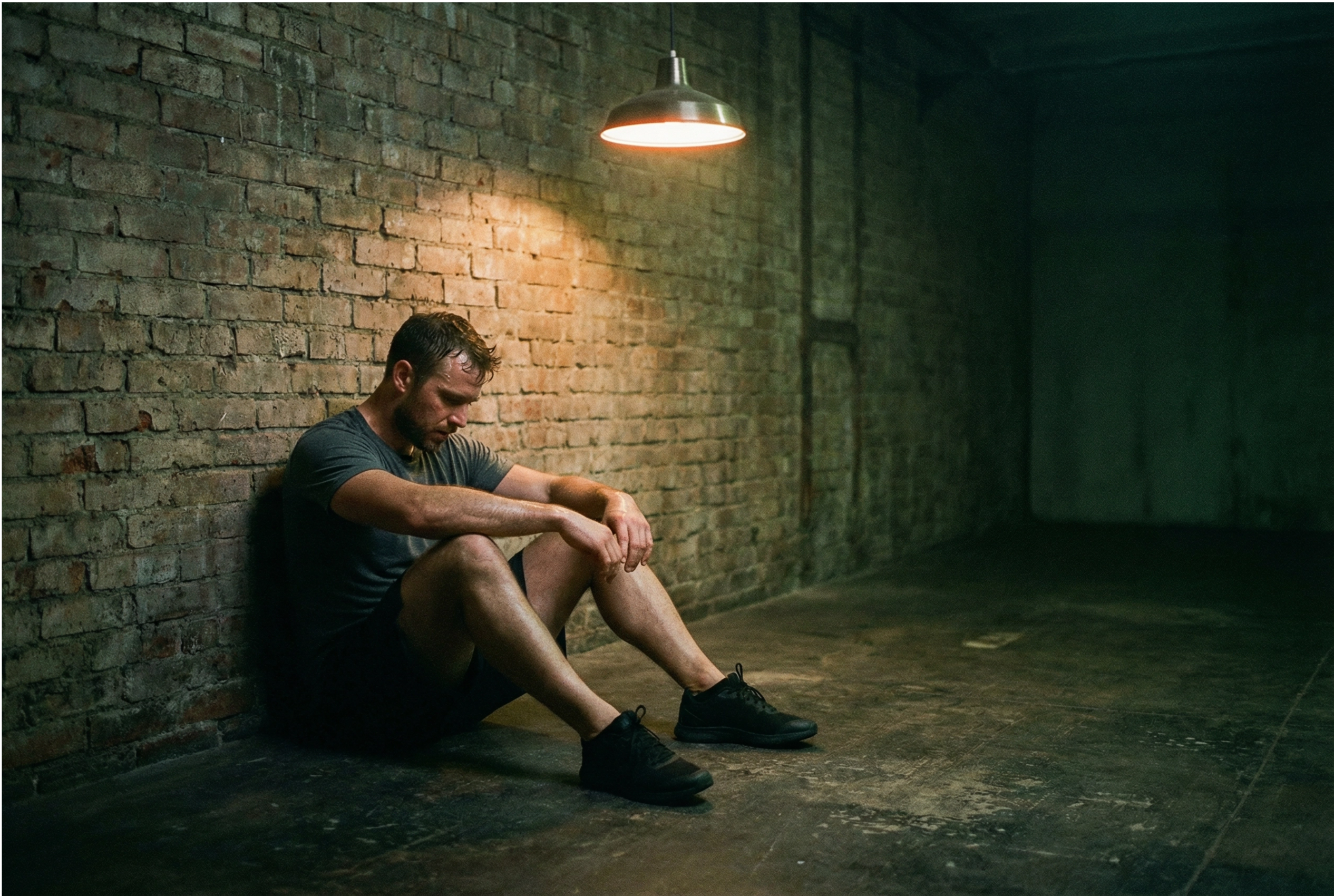
Stop Recovery Gimmicks: Real Strategies for Men Over 30 UK
The Recovery Industry Is Making You Fragile (And Selling You the Solution)
You're doing everything right.
Training consistently. Following the programme. Pushing hard in sessions. Then you see the Instagram post: elite athlete in an ice bath, massage gun beside them, infrared sauna glowing in the background. Caption: "Recovery is where champions are made."
So you ask yourself: "How can I recover quicker?"
And the fitness industry has an answer ready. Actually, it has about 47 answers ready. All of them involve buying something.
Cold plunge tank. Massage gun. Fascial stretch tower. Reformer Pilates. Compression boots. Infrared sauna. The list grows longer every month, and the message is always the same: the more you invest in recovery tools, the faster you'll bounce back.
I think this is largely wrong.
Not because the tools themselves are bad. They aren't. But because the narrative around them is hijacking something far more important: the development of real fitness, real strength, and real self-knowledge.
My answer when someone asks how they can recover quicker is almost always the same:
Get fitter and stronger. That is your recovery tool.
That answer frustrates people. They want a protocol. They want a product. They want the shortcut.
But the shortcut is the problem.
What's Actually Happening (And Why It's Not Your Fault)
The modern fitness industry has always been in the business of harnessing false beliefs.
The underlying message is always the same: I can make this easier for you.
And people are buying it — literally — because it feels like progress without the pain.
Recovery tools give you a false sense of control. "I've done my massage gun. I've done my cold plunge." It lets you feel like you're doing something meaningful about your recovery.
But here's what's really happening: you're taking the easy option.
And the easy option strokes the ego without addressing the real issue.
The fitness industry isn't pushing recovery tools because they're the most effective solution. They're pushing them because they sell. Because they're pleasant. Because they give you something tangible to point to.
The easy road never takes you home — but it's a hell of a lot easier to market.
The Psychology Is Being Hijacked
Here's the most important thing I discovered when I really dug into this:
The tool isn't the villain. The false belief the industry attaches to the tool is the villain.
I use a massage gun. I use a cold plunge. I did both recently — the massage gun on a sore knee this morning, the cold plunge after a 50-mile mountain run to manage acute inflammation.
Neither was wrong. Neither was the problem.
The problem is this:
If someone believes the massage gun is the fix for the sore knee, that belief stops them from identifying and implementing the real fix.
In my case, the real fix is load management. The massage gun can coexist with that. But the moment it becomes the answer instead of part of the picture, it actively makes things worse by obscuring the root cause.
This is the psychology being hijacked. You reach for the tool because it's available, because it's marketed at you, because it gives a feeling of resolution — when the real resolution requires harder, longer, less glamorous work.
People Are Sacrificing Sleep for Recovery Tools
I've seen someone return from a training session at 11:30pm and then spend 30 minutes in a cold plunge.
What they actually needed was a two-minute cool-down and to get their head down.
Sleep is the most powerful recovery tool that exists.
They traded it for something that sits several positions lower on the hierarchy, because the cold plunge felt more like "doing something."
That's not just ineffective. That's actively counterproductive.
They made their recovery worse in pursuit of better recovery.
The irony would be funny if it weren't so common.
The Real Recovery Hierarchy (What Actually Matters)
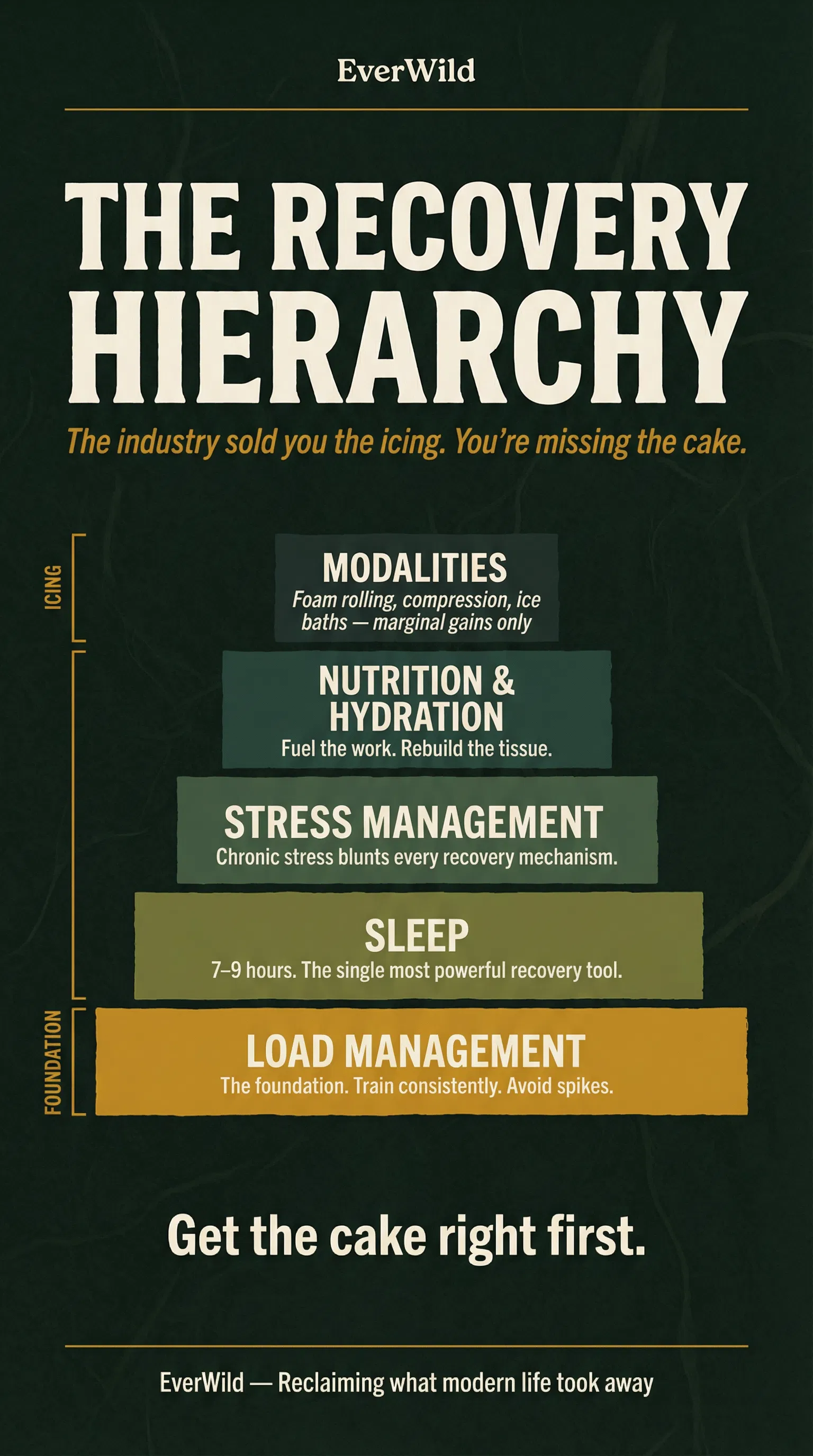
A 2023 research review published in Sports explicitly framed recovery as a hierarchy.
Sleep, nutrition, and training periodisation were described as "the cake" — the fundamental pillars with the greatest evidence base and the largest overall contribution to recovery.
All supplementary modalities — foam rolling, compression, cryotherapy, massage guns, saunas — were classified as "the icing". Potentially marginal additions that should only be considered once the fundamentals are optimised.
When I actually sit with what drives recovery — not what's trendy, but what the evidence and experience point to — this is how it stacks up:
1. Load Management
The absolute number one. This is the root cause of most recovery problems.
2. Fitness and Strength
The fitter and stronger you are, the less recovery you need from equivalent work.
3. Sleep and Stress Management
These sit together. Sleep is the most powerful recovery tool that exists. And psychological stress and training stress draw from the same physiological pool.
Chronic stress elevates cortisol, impairs tissue repair, and amplifies pain perception. You cannot out-sleep a life full of unmanaged stress, and you cannot out-train it either.
4. Nutrition and Hydration
The raw materials for repair and adaptation.
5. Quality Movement Patterns and Auxiliary Fitness
Balance, coordination, agility, reaction speed.
6. Mobility Work
7. Recovery Tools
Massage guns, cold plunges, saunas, fascial work.
Useful. Marginal.
It's worth noting that these elements are deeply interconnected. If you manage your load impeccably but carry chronic psychological stress, your body is still in a state of systemic inflammation.
The hierarchy matters, but it doesn't operate in isolation.
Load Management: The Most Neglected Fundamental
If I had to identify the single most common recovery mistake I see, it's poor load management.
Not lack of massage guns. Not insufficient cold exposure. Poor load management.
This shows up in predictable patterns:
Compressing all weekly training into Friday, Saturday, Sunday — then wondering why Monday is agony
Doing nothing for two weeks and then going full throttle for one — and asking about mobility exercises to manage the fallout
Increasing volume or intensity too sharply without building a base to absorb it
The research here is blunt.
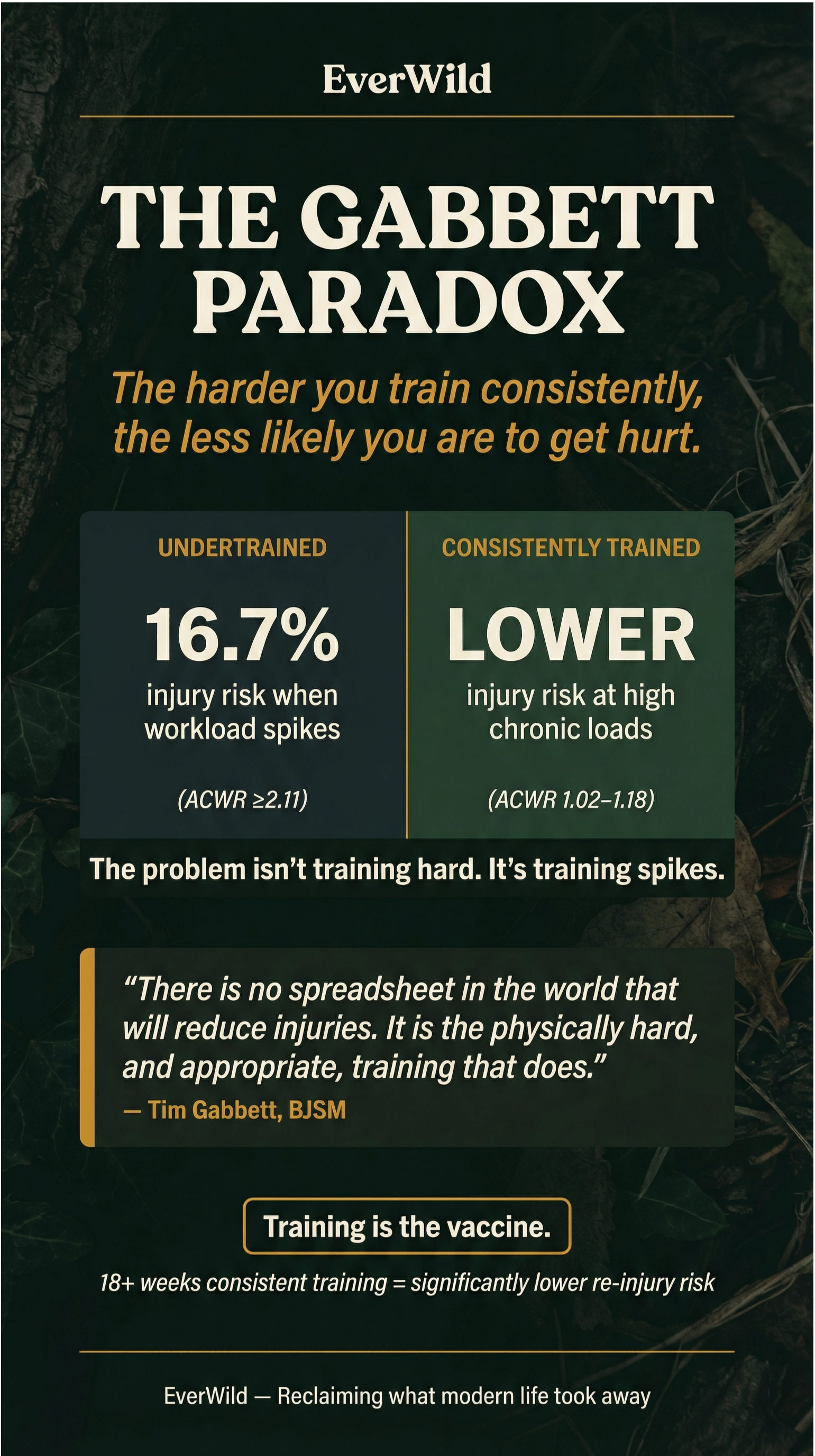
When the acute:chronic workload ratio — the ratio of what you did this week versus your average over the past month — spikes to 2.11 or above, injury risk that week sits at 16.7%.
That's what happens when someone does nothing for two weeks and then trains hard.
A 10% spike in weekly load is associated with 40% of injuries. A 15% spike increases injury risk by nearly 50%.
Tim Gabbett, whose work on training load and injury prevention is the most cited in this space, put it plainly:
"There is no athlete monitoring system in the world that will reduce injuries. It is the physically hard and appropriate training that reduces the risk."
The answer isn't a recovery tool. The answer is consistent, intelligently loaded training that builds what he calls a chronic fitness base — the body's accumulated readiness to handle work.
Consistently trained athletes have fewer injuries than undertrained ones.
This is the training–injury prevention paradox. The body that is regularly challenged adapts. The body that is periodically hammered after long gaps does not.
And no cold plunge fixes the gap.
I have a sore right knee right now. I know exactly why: poor load management on my part. I'm not immune to this.
And I'm not going to kid myself that a cold plunge or a massage gun is going to fix it. The massage gun can help it feel better in the short term. But that is not the fix.
The fix is addressing what went wrong in the load and adjusting it.
Get Fitter, Recover Faster: The Training-Recovery Paradox
Here's something the recovery industry doesn't want you to know:
The fittest people recover the fastest.
Not because they have better recovery protocols. Because their bodies have adapted to handling work.
This is called the Repeated Bout Effect.
When a muscle is exposed to an exercise stimulus repeatedly, subsequent bouts produce:
Markedly reduced DOMS (delayed onset muscle soreness)
Less muscle damage
Less swelling
Faster recovery of force production
This protective effect can last up to 24 weeks.
Research comparing trained and untrained individuals confirms this: untrained participants experienced soreness after just one day of high-intensity exercise, while trained participants didn't report significant soreness until after three days of consecutive high-intensity work.
Translation:
The most effective "recovery strategy" for reducing soreness and bouncing back faster from training is simply to train consistently at appropriate loads so the body adapts.
Not to buy another gadget.
The Cold Plunge Problem: When Recovery Tools Work Against You
I use cold plunges. I want to be precise about when and why — because the evidence here is something most people in the recovery space are either unaware of or choosing to ignore.
Acute use after significant endurance events — a 50-mile mountain run, for example — where the goal is to manage acute inflammation and get the body functional again: the evidence supports this. Perceived soreness reduces. That's a legitimate use.
Chronic use after resistance training sessions to speed up recovery: the evidence is unambiguous, and it goes in the opposite direction to what people expect.
Multiple peer-reviewed studies now show that regular cold water immersion following strength training blunts muscle hypertrophy — the actual adaptation you are training to achieve.
It attenuates anabolic signalling, increases catabolism, and reduces both whole-muscle growth and Type II fibre cross-sectional area.
The conclusion from one research group was direct: "Post-exercise cold water immersion should be avoided if muscle hypertrophy is desired."
I tell my clients this consistently. If you are doing strength sessions and then getting in an ice bath because you think it is accelerating your progress, you are working against yourself.
You are not recovering faster. You are recovering from less — because you have suppressed the adaptation your session was designed to create.
This is the recovery industry selling you something that feels productive, feels disciplined, feels like a performance edge — while the actual performance edge is being quietly undermined.
The tool is being used in the wrong context, at the wrong time, with a false belief attached to it.
The Industry Is Making You Fragile
This is the part of the recovery conversation that is almost completely absent from mainstream fitness, and I think it is the most important.
When the industry teaches you that your body needs an elaborate recovery protocol to handle normal training stress — the ice bath, the massage gun session, the 45-minute fascial work sequence — the implicit message underneath all of it is:
Your body cannot handle this without help.
That message has real physiological consequences.
The Nocebo Effect
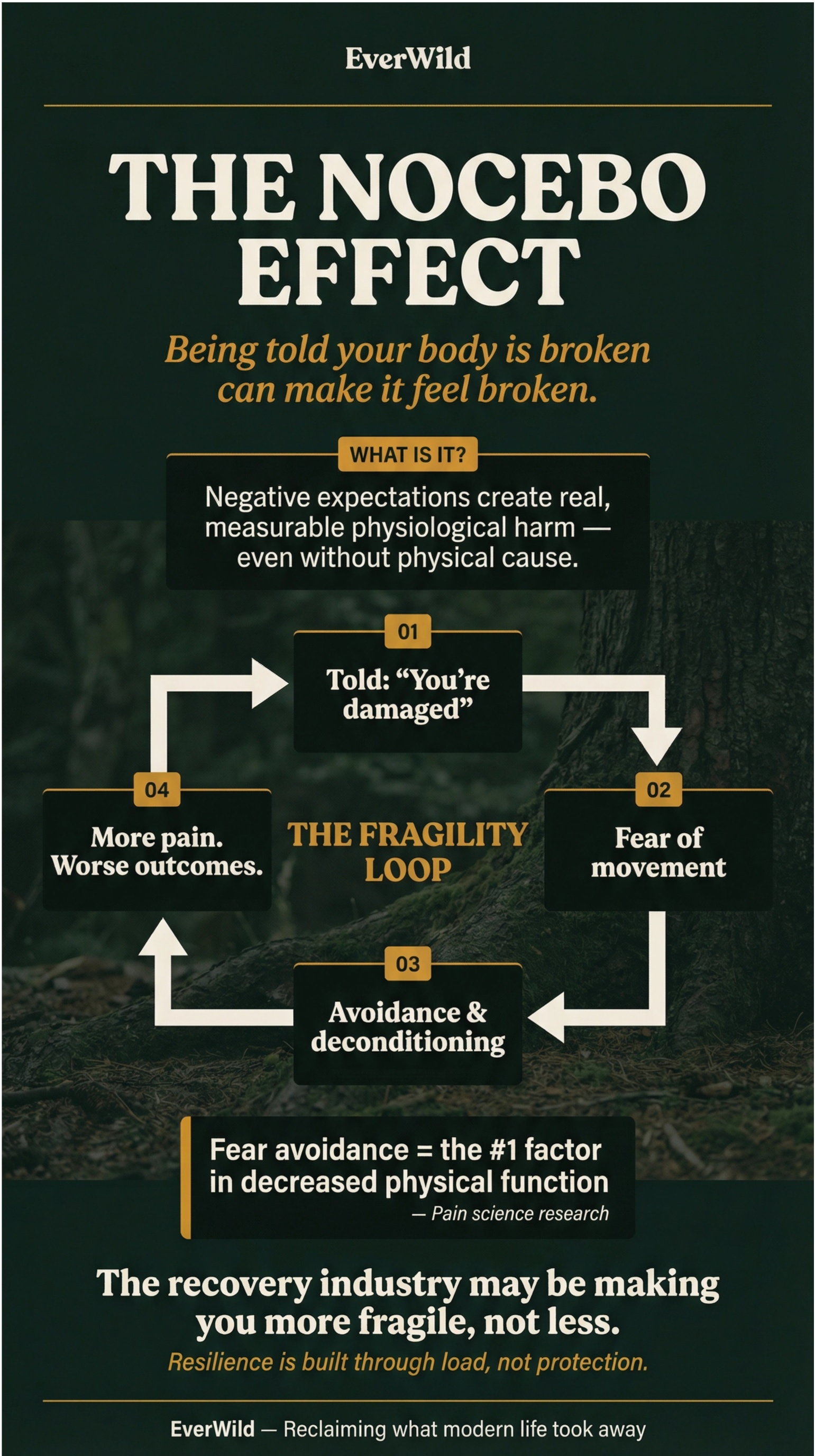
The research on nocebo effects — the harm caused by negative expectations — is clear.
When people are told their body is fragile, damaged, or unable to cope without intervention, pain perception increases, cortisol rises, and recovery slows.
The expectation of damage creates measurable physiological harm.
You are not imagining it. The belief itself is doing it to you.
The Fear-Avoidance Cycle
The fear-avoidance research takes this further.
When people develop the belief that training causes damage — that movement is a threat requiring elaborate management — they begin to avoid loading.
Avoidance leads to deconditioning.
Deconditioning worsens pain and increases injury risk.
That worsening reinforces the original fear.
The cycle deepens.
This is the vicious loop the recovery industry is quietly creating: sell the fragility narrative, sell the solution to the fragility, watch the fragility deepen, sell more solutions.
What Actually Builds Resilience
The evidence on tissue healing is relevant here too.
Biological repair follows a fixed timeline — no tool accelerates the fundamental biology.
Phase Timeframe Key Process Inflammation 1–3 days Immune response, debris clearance Proliferation 4–21 days New collagen, tissue bridging Remodelling 21 days–1+ year Collagen reorganisation, strength restoration
What the research consistently shows is that the most important factor for tissue quality during remodelling is appropriate progressive loading.
Not passive interventions. Not rest dressed up as recovery. Loading.
The tissue gets stronger by being loaded intelligently.
Strength and tendon capacity come from progressive loading — not from what you do to yourself afterward.
What Gets Lost: Self-Knowledge
When you outsource your recovery understanding to a product, you bypass the learning cycle entirely.
The learning cycle that happens when you commit to training for an extended period — paying attention to what's working, what isn't, reading your own body — that is where genuine self-knowledge is built.
Self-belief in the adaptability of your body.
Confidence in your own capacity to absorb and adapt.
The false sense of control that recovery tools provide isn't neutral. It actively erodes that self-knowledge.
And when the self-knowledge doesn't develop, the fragility narrative fills the gap.
You become more dependent on the tools, more convinced your body can't function without them, less capable of the real adaptation that was available to you all along.
The recovery industry isn't just selling you a distraction. At its worst, it is making you genuinely more fragile — not less.
The Nuance: When Recovery Tools Are Fine
I want to be precise here, because this isn't a blanket condemnation.
Recovery tools can be useful when:
The fundamentals are already in good order — load management, sleep, stress, nutrition
They're used as an adjunct, not a replacement for fundamentals
There's a specific, acute reason — managing significant inflammation after an extreme endurance event, for example
They serve a secondary purpose beyond recovery — mindfulness, mental reset, a ritual that supports wellbeing
Cold exposure is used for its psychological and presence-building value rather than as a post-strength-session recovery tool
What they are not is a solution to poor fundamentals.
And they should never be prioritised above the things that sit above them in the hierarchy.
The moment you sacrifice sleep for a sauna session, you have the hierarchy exactly backwards.
And specifically regarding cold water immersion: if you are a strength-focused athlete using it regularly after sessions, the evidence is clear enough to act on.
Use it selectively, for the right reasons, at the right times — or accept that you are trading adaptation for short-term comfort.
There is also a legitimate psychological argument that for someone in the early stages of building fitness — genuinely suffering with DOMS, wondering whether their body will hold together — a massage gun or a cold plunge might help them stay in the game long enough to build the base they need.
That's not nothing. But it should be understood for what it is: a psychological support mechanism during an early phase, not a physiological fix and certainly not a long-term dependency.
What Actually Works (The Boring Truth)
The recovery trend is the fitness industry doing what it always does: harnessing a false belief, making it easier, and selling you the comfortable option.
But it's worse than that.
The comfortable option here doesn't just waste your time and money. It actively undermines the adaptation you're training for.
It teaches your nervous system that your body is fragile.
It creates the fear-avoidance cycle that makes you less capable over time, not more.
And in the specific case of chronic cold water immersion after strength training, it is directly suppressing the physiological gains your sessions were designed to produce.
The recovery tools industry tells you that recovery is a thing you do to your body, with products, after training.
The reality is that recovery is what your body does — given appropriate load, consistent training over years, sleep, nutrition, and a psychology that trusts adaptation rather than fears damage.
Gabbett put it better than I can: there is no monitoring system, no database, no spreadsheet that reduces injuries. It is the physically hard and appropriate training that does it.
The body that is consistently challenged adapts. The body taught to fear challenge does not.
The Practical Hierarchy (What to Actually Do)
If you're serious about recovery, here's the order of operations:
1. Sleep
7-9 hours per night. Non-negotiable. The single most impactful recovery intervention with no risk of blunting adaptations.
If you're sacrificing sleep for anything else on this list, you've already lost.
2. Nutrition
Adequate energy availability. Post-exercise protein and carbohydrate. Hydration.
Not complicated. Not sexy. But fundamental.
3. Load Management
Distribute training evenly through the week. Avoid spikes. Build chronic training loads progressively.
Keep your acute:chronic workload ratio around 0.8-1.3. Don't hammer yourself after two weeks off and wonder why you're broken.
4. Consistent Training
The repeated bout effect means regular, well-dosed training is itself the most powerful recovery enhancer.
Show up. Do the work. Let your body adapt.
5. Supplementary Modalities
Foam rolling, compression, cold water immersion (used selectively and not chronically post-resistance training), and sauna may offer small perceptual benefits.
But they should never displace fundamentals.
The Through-Line
The easy road never takes you home.
Build the fitness. Manage the load. Sleep. Manage your stress. Eat.
Trust your body's capacity to adapt — because that trust is itself part of the recovery.
Then, if you still think you need it, and the fundamentals are genuinely solid, pick up the massage gun.
But understand what it is: a marginal addition to a solid foundation. Not the foundation itself.
Ready to Build Real Capability?
The ReWilding System isn't about recovery gimmicks or quick fixes.
It's about building genuine, multi-dimensional capability that lasts.
Inside The ReWilding System:
Complete training frameworks that build fitness and strength (your actual recovery tools)
Load management principles that prevent injury before it happens
Sleep and stress protocols that actually move the needle
Nutrition guidance focused on fundamentals, not supplements
The complete 8-system activation framework (including recovery in its proper place)
Not another product promising shortcuts. A truly holistic approach to building Wild Capability.
>>>Join The ReWilding System<<<
£147 for the year, for the next 5 guys.
No subscriptions, no tie ins, just a 1 years access to the good stuff.
Let's hunt.
— Luke, EverWild

